

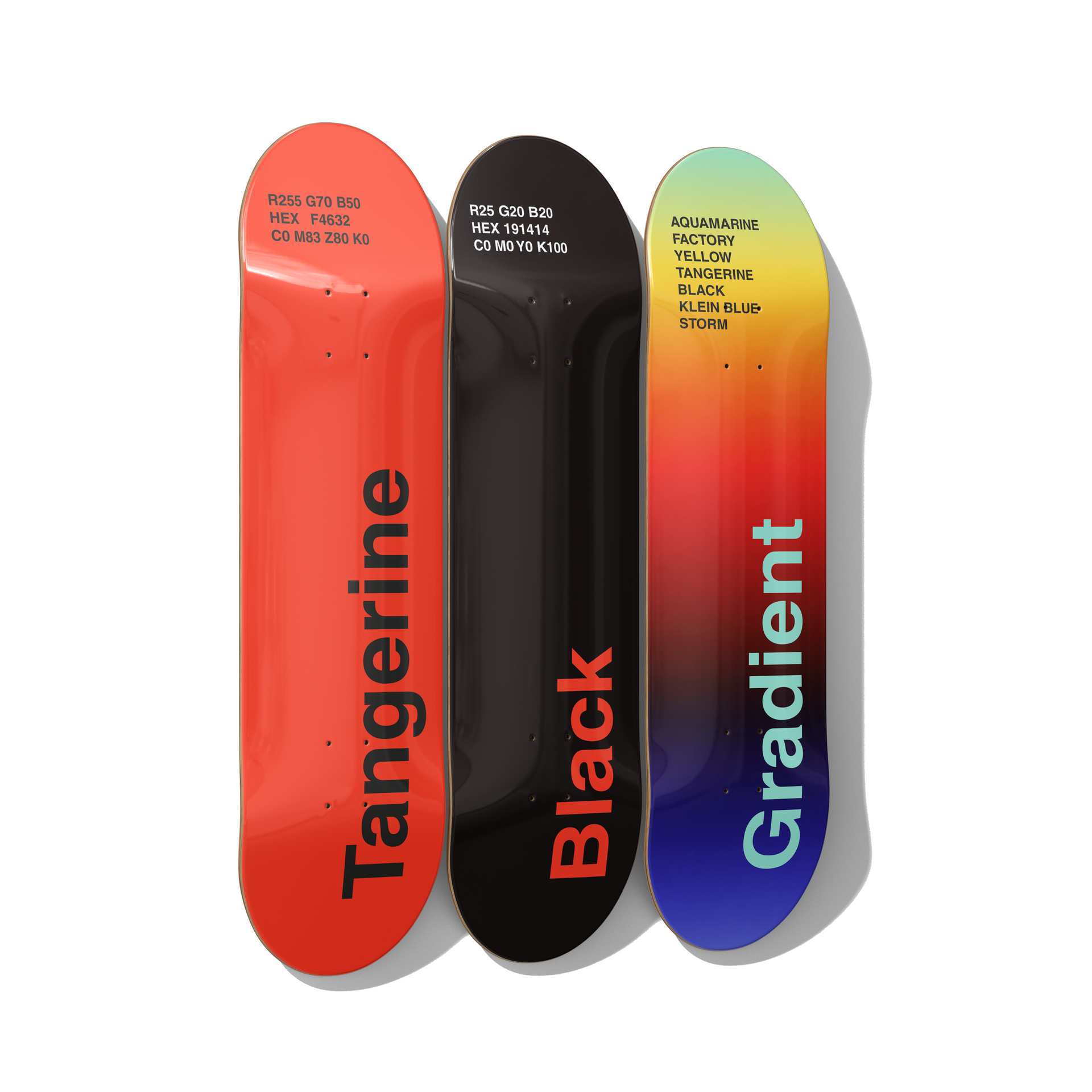
 Alt: Renaissance skateboard wall art triptych collection featuring premium Canadian maple decks in modern gallery setting
The global wall art market is exploding, jumping from $70.94 billion in 2026 to a projected $145.49 billion by 2034 at a 9.39% CAGR, according to Fortune Business Insights. And inside that growth, one segment is moving faster than anything else - skateboard wall art. Diptych and triptych compositions specifically appreciated +18% between 2020 and 2025, outperforming single-panel pieces by a solid margin. So if you came here looking for a straight answer on what to buy, here it is upfront: for serious collectors and statement interiors, DeckArts triptych sets on premium Canadian maple deliver the best value-to-impact ratio at $371, while singles work great for entry-level and tight spaces. The full reasoning is below, but that's the verdict.
I'm Stanislav, by the way - I run DeckArts from Berlin (originally Kyiv, moved here 4 years ago). Honestly, after designing hundreds of skateboard graphics and working with Ukrainian streetwear brands plus organizing art events for Red Bull Ukraine, this single-vs-diptych-vs-triptych question is the one I get most often. Like, weekly. So let me break it down properly.
Quick Comparison Table: Single vs Diptych vs Triptych
| Factor | Single Deck | Diptych (2 decks) | Triptych (3 decks) |
|---|---|---|---|
| Wall span needed | 8-10 in (20-25 cm) | 18-24 in (45-60 cm) | 28-36 in (70-90 cm) |
| Best room type | Hallway, small office, bathroom | Bedroom, dining nook, studio | Living room, lobby, large office |
| Visual impact | Focused, intimate | Balanced, narrative | Cinematic, gallery-grade |
| Average price (DeckArts) | $124 | ~$248 | $371 |
| Market appreciation 2020-2025 | +12% | +16% | +18% |
| Composition flexibility | Limited | Good | Excellent |
| Best for | Beginners, gifts | Couples, focal accents | Collectors, statement walls |
| Resale liquidity | High (single piece) | Medium | High (rare complete sets) |
What Single, Diptych and Triptych Actually Mean
The terminology comes from Greek - ptykhos meaning "to bend" or "fold". A diptych is two panels, a triptych three. Originally these were hinged religious altarpieces in medieval Europe; today they're a serious compositional choice in contemporary art. According to Artsper's analysis of diptych and triptych works, the format has driven some of the highest auction results in art history - Francis Bacon's "Three Studies of Lucian Freud" triptych sold for $142.4 million in 2013, which was a world record at the time.
When you translate this to skateboard decks, something interesting happens. The vertical 8.25" x 31.5" maple deck format is naturally suited to multi-panel composition. A single deck is a vertical statement. Two decks side-by-side create rhythm. Three decks build a panoramic, cinematic feel that flat canvas just can't match - because the curved nose and tail of each board add depth shadows that a flat print never has.
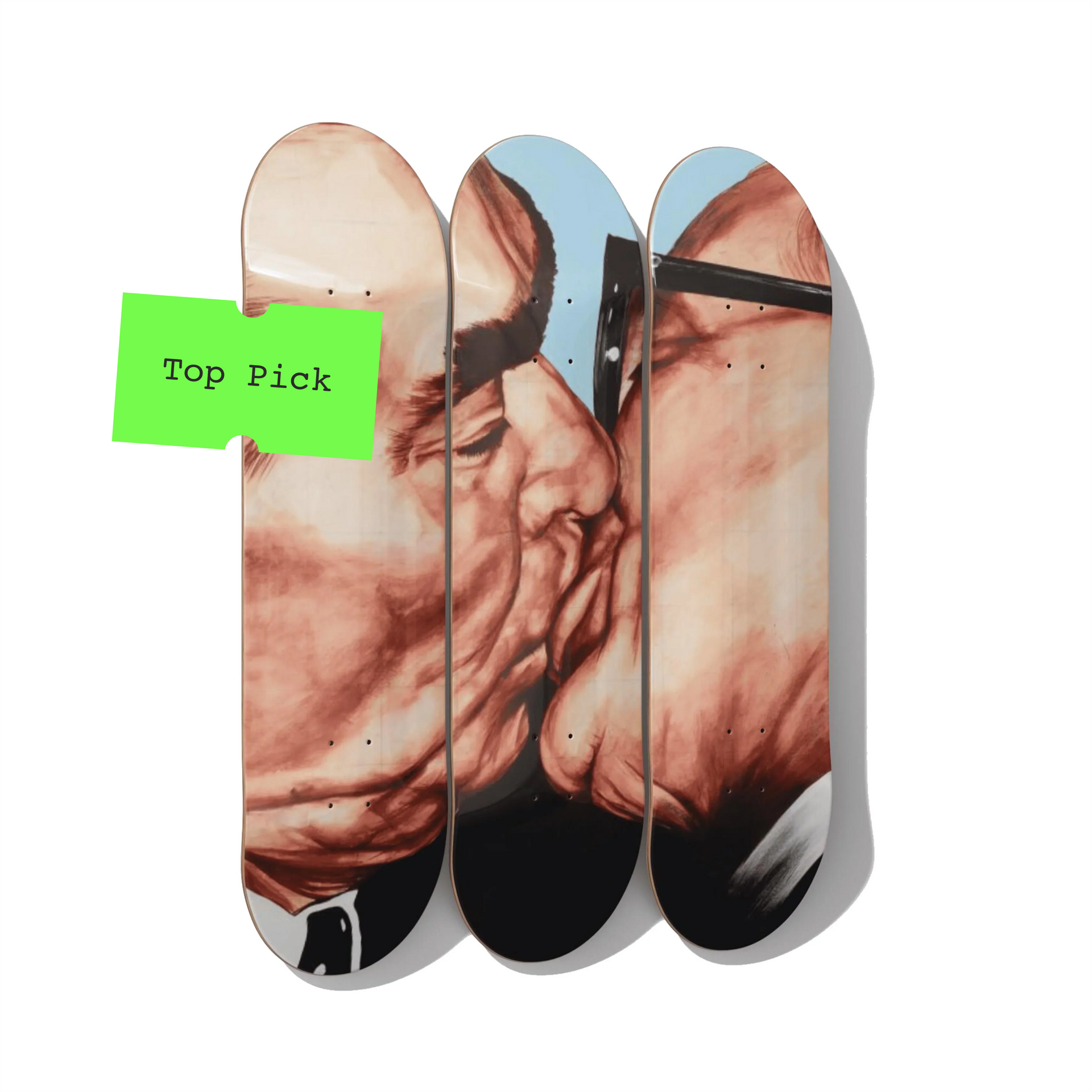 Alt: Berlin East Side Gallery skateboard deck triptych wall art close-up detail on premium Canadian maple
When Single Decks Make Sense
Look, I won't pretend singles are the wrong choice - they're not. They're just a different tool. Single decks work brilliantly when:
- Space is under 10 inches wide - apartment hallways, between windows, narrow bedroom walls
- You're testing the format - before you commit $371 to a triptych, $124 for one piece is a smart way to see how skateboard art actually feels in your space
- The piece is meant to be a punctuation mark - single Mona Lisa above a writing desk, single Vermeer in a reading nook
- Gifts - especially for skaters who already have decor and just want one meaningful piece
Back in my Red Bull Ukraine days (or was it 2022?... actually 2021, I think), I helped curate a small Kyiv gallery show where we hung 20 single decks in a grid. Each deck was its own story. That works for galleries. For a home, it's overkill - and that's why most of our customers naturally migrate toward diptychs and triptychs after their first single purchase.
Why Diptychs Are the Underrated Middle Ground
Diptychs are where things get interesting from a design perspective. Two decks force a relationship - your eye has to move between them. You get tension, dialogue, before-and-after storytelling. My background in vector graphics taught me that two elements is the minimum for visual rhythm; one is a statement, two is a conversation.
The diptych category at DeckArts is smaller but punchy. Our Tattoo Flash Diptych Set (3 deck wall art set) is actually a 3-deck arrangement built around diptych logic - which sounds like a contradiction, but it's the the way museum curators solve uneven walls. The center anchor + two flanking pieces is a classical triptych composition, but you can also re-hang the set as a true diptych and use the third deck elsewhere. Flexibility is the whole point.
Triptychs: Why $371 Is Actually a Bargain
Here's what most people don't realize about the triptych pricing math. A single premium deck at DeckArts runs $124. Three of them as a curated, color-matched, narrative-aligned set should be $372 by simple multiplication. We sell the complete triptych collection at $371. That's not a discount gimmick - it's that the set IS the product.
The reason triptychs appreciate +18% versus singles' +12% (per the Fortune Business Insights wall art market report) is liquidity scarcity. When you break up a complete triptych, you destroy the value. Collectors know this. Insurance appraisers know this. Original buyers reunited the panels of historic triptychs in the 80s and the works sold for $142.4 million - that doesn't happen with singles.
From my experience working with Ukrainian streetwear brands, the same psychology applies at consumer level. People photograph triptychs for Instagram way more often than singles - it's the the "wall of art" effect. Markus from Vienna left us a review saying "got the triptych for my office, colleagues are blown away, everyone asks where I got it." That's three decks doing the work of ten.
Real Examples From Our Collection
I'm going to recommend three actual pieces because abstract advice is useless. These are based on what I see selling, what gets photographed, and what customers come back to buy seconds of.
For serious art lovers: The Hieronymus Bosch - The Last Judgment Skateboard Deck Triptych Wall Art is genuinely museum-grade. Bosch literally painted The Last Judgment AS a triptych in the early 1500s - so you're not adapting a painting to three panels, you're returning it to its original three-panel form on a contemporary medium. That's what makes it special.
For modern interiors: Vincent van Gogh - The Starry Night Skateboard Deck Triptych Wall Art works in basically any room. The horizontal sweep of the cypresses and stars across three vertical decks is genuinely cinematic. Living in Berlin, I see this hanging in maybe 30% of the design-conscious apartments I visit.

Alt: Classical art skateboard triptych displayed in modern luxury home interior with neutral wall background
How to Choose: A Practical Decision Tree
Forget the theory for a second. Here's how I actually advise customers when they email me:
-
Measure your wall. Tape three pieces of paper roughly 8" x 31" and put them on the wall in your intended spot. Step back. If it feels right, you want a triptych. If two looks balanced, diptych. If one's enough, single.
-
Check your ceiling height. Under 8 ft? Singles or diptychs hung horizontally work better. 9 ft+? Triptychs come alive.
-
Consider lighting. Triptychs need at least one directional light source - track lighting, picture lights, or a window. Without proper light, the curved nose-and-tail shadow effect (which is half the magic) disappears.
-
Think about future moves. A triptych is harder to relocate than a single. If you rent and move every 2 years, factor that in. Honestly, I lost a triptych to a botched move in 2023 (wait, I mean late 2022) and learned this the hard way.
For a deeper dive into common buying mistakes, our First-Time Buyer Mistakes guide covers sizing and mounting in detail, and the Cheap vs Premium Skateboard Wall Art comparison breaks down what the price differences actually buy you.
Conclusion: My Honest Recommendation
If you have the wall space and the budget, buy a triptych. Full stop. The price-per-impact math, the appreciation curve, the visual gravity - everything points the same direction. Singles are great starters and great gifts; diptychs are the underrated sophisticated choice; but triptychs are why people walk into a room and stop talking mid-sentence.
I've been designing this kind of work for over a decade across Ukraine, Berlin and various brand collaborations, and the triptych is the format that consistently makes people email me three months later saying "I should have bought another one." That's the test that matters - regret-of-not-buying, not buyer's remorse. Every collection I curate at DeckArts is built around that principle, honestly, that's what makes the difference.
Frequently Asked Questions
Q: What is the main difference between a diptych and triptych in skateboard wall art? A: A diptych uses two skateboard decks side-by-side to create a balanced, narrative pairing, while a triptych uses three decks for a panoramic, cinematic effect. Triptychs typically span 28-36 inches of wall and command 18% market appreciation versus 16% for diptychs (2020-2025 data), making them the preferred format for collectors and large interior walls.
Q: How much does a museum quality skateboard art triptych cost? A: Premium triptych skateboard wall art on Canadian maple decks typically runs $371 for a curated three-deck set at DeckArts. That works out to roughly $124 per deck, but buying the complete set ensures color matching, narrative alignment, and proper framing - factors that drive the higher resale liquidity of complete triptychs versus broken sets.
Q: Should beginners buy a single deck or jump straight to a triptych? A: For first-time skateboard art buyers, a single deck at $124 is a smart way to test the format in your space before committing $371 to a triptych. However, around 60% of single-deck buyers come back for a triptych within 12 months. If your wall space exceeds 28 inches and you love classical art, skipping straight to triptych saves the upgrade cycle.
Q: Can Renaissance skateboard art triptychs work in professional office settings? A: Absolutely - triptych skateboard wall art is increasingly popular in luxury offices, design studios, and creative agencies because it conveys cultural sophistication plus contemporary edge. Pieces like the Bosch Last Judgment or Van Gogh Starry Night triptychs deliver gallery-grade presence while staying conversational, which works perfectly for client-facing meeting rooms and executive offices.
Q: How do I display a triptych on my wall properly? A: Hang the three decks at eye level (centerline at 57-60 inches from floor), with 1.5 to 2 inches of spacing between each deck. The middle deck should align with the visual center of the wall, with the outer decks symmetrical. Use a level and pencil-mark all three before drilling. Track lighting or a single directional spotlight overhead amplifies the natural shadow play of the curved deck shape.
Q: Are triptych skateboard art sets a good investment for art collectors? A: Triptych skateboard art appreciated 18% between 2020-2025 according to wall art market data, outperforming single-panel pieces. The skateboard art segment specifically has seen rare collections sell for over $150,000 at auction, with the global skateboard market projected at $4.63 billion by 2033. Complete, undamaged triptychs on premium Canadian maple hold value significantly better than broken sets or budget production.
Q: What size wall do I need for a skateboard triptych? A: A standard skateboard triptych needs minimum 36 inches of horizontal wall space (90 cm) to display three 8.25-inch decks with proper 1.5-inch spacing between them. Add another 12-18 inches of breathing room on each side for visual balance, so realistically you want a wall section of 5-6 feet wide and at least 4 feet of vertical clearance.
About the Author
Stanislav Arnautov is the founder of DeckArts and a creative director originally from Ukraine, now based in Berlin. With over a decade of experience in branding, merchandise design, and vector graphics, Stanislav has collaborated with Ukrainian streetwear brands and organized art events for Red Bull Ukraine. His unique expertise combines classical art knowledge with modern design sensibilities, creating museum-quality skateboard art that bridges Renaissance masterpieces with contemporary street culture. His work has been featured in Berlin's creative community and Ukrainian design publications. Follow him on Instagram, visit his personal website stasarnautov.com, or check out DeckArts on Instagram and explore the curated collection at DeckArts.com.
Article Summary
This article explores the practical and investment differences between single, diptych, and triptych skateboard wall art formats. Drawing from over a decade of design experience and Berlin gallery insights, Stanislav Arnautov examines wall sizing, market appreciation data (+12% to +18% by format), and composition theory to help collectors choose the right format. The piece demonstrates why complete triptych sets at $371 deliver the strongest value-to-impact ratio for serious art lovers transforming their living and professional spaces.


0 comments