
Interview · By Stanislav Arnautov · Berlin
Quick answer: Svenimal — the artist name of Dutch drummer, teacher and painter Sven Bakker — makes unique one-of-one painted skateboards, often on worn or old-school decks, in a style he ties to funk, early hip-hop and skateboard culture. In this Svenimal skateboard art interview he talks about teaching drums and drawing, a Judas Priest hammerhead deck, a bird-skull painting on an original Powell Peralta board that later reached Tony Hawk, and why he is turning older drawings into prints.
About Svenimal

Sven Bakker, better known as Svenimal, is a professional drummer, drum teacher, graphic artist and drawing teacher from the Netherlands. He is based in the Hoorn area, where he runs Studio Svenimal, the drum and drawing school he started in 2005. He studied Jazz & Pop at Alkmaar Conservatory, and he also teaches graffiti workshops and drawing, including work with De Tekenacademie.
On his own site he describes himself as a committed vegan, and sums up the work simply: he drums, draws, creates and educates. Hip-hop and skateboard culture, he writes, have shaped him musically and artistically. He paints murals and portraits, designs logos and tattoos, photographs concerts, and paints objects — especially skateboards — as one-of-one pieces. As an artist he is mostly self-taught, later sharpened at De Tekenacademie and Het Tekenlab, with a long interest in early graffiti writers, skateboard graphics, tattoo art and underground comics.

We asked him ten questions about skateboard art. His answers are kept in his own words, with only light typo corrections. Follow his work on svenimal.art, Instagram: @svenimal.art, YouTube: @svenimal-art and Facebook: Svenimal.Art.
How music, art and teaching feed each other
You describe yourself very simply: “I drum, draw, create and educate.” Do music, art and teaching feel like three separate parts of your life, or do they constantly influence each other?
I started teaching kids at the marching band where I had started playing drums myself at the age of six or seven. This was even before I went on to study at the Conservatory and art schools.
Teaching gave me much more satisfaction than the lousy jobs I had back then. So, starting my own drum school while studying at the Conservatory felt like a logical next step. A few years later, I started combining that with drawing and graffiti workshops.
Different art forms have a lot in common. First, you learn the alphabet, then you start forming simple sentences through copying and trial and error. Eventually, you learn to create your own stories and choose your own direction and style.
For instance, when drawing a portrait, you can make it more interesting by learning to recognise the different planes and shapes in a face. It's the same with drumming: you have to train your ears to recognise details and different parts of a song, so you can lift it with dynamics and subtle details.
So yes, for me, all these things complement each other and keep me continuously connected to the creative learning process.
What 70s and 80s skate and hip-hop culture still give him
You grew up with a strong interest in underground art, early hip-hop, graffiti and skateboard culture from the 70s and 80s. What from that era still influences what you create today?
There's a well-known saying that what influences a kid between the ages of 13 and 17 has a huge impact on how they develop their sense of identity and self-worth.
Growing up outside cities like Amsterdam or Rotterdam, most of my peers were into soccer and things like that. Although I have to say that this was also around the time when toy skateboards and BMX bikes started appearing more frequently. I'm talking about those plastic skateboards, similar to what we now call Penny boards. BMXes, partly thanks to movies like E.T.
At first, I didn't have a clue about real skateboarding. Then I came across an article in a Dutch music magazine featuring skateboarders wearing colourful shirts with graphics and brightly coloured kneepads.
The whole colourful style, with skulls and weird graphics, immediately caught my attention. Later, when I saw skateboarding footage on Super Channel, the music, editing and overall atmosphere got me hooked as well.
The same thing happened with hip-hop after I saw Hey You by the Rock Steady Crew, with its combination of b-boying, breakdancing and graffiti by Bill Blast.
It wasn't until I was around 18 and started visiting Amsterdam regularly that I saw these cultures really coming together.
There was a shop called Vibes that sold skateboard decks, but also graffiti magazines and streetwear. Bands and artists like Urban Dance Squad, Bomb The Bass and Beastie Boys were mixing hip-hop with punk and other influences in their music and videos.
I think all of this is still very visible in my art. Whether it's a portrait of a musician, skateboarder or another artist, or the actual canvas or medium I use: a skateboard as a canvas or spray paint as a medium. As soundtracks for the making-of videos on my YouTube channel, I mainly record drum tracks to songs related to these cultures.

Funk as the common factor in drumming and drawing
You first pursued music professionally and studied at the Conservatory before developing your visual art practice further. Do you feel your musical background changed the way you think about composition, rhythm or even colour in your artwork?
I kind of touched on this in my answer to the first question.
My passion for drawing never faded, but at some point I had to decide which direction I wanted to take if I wanted to work professionally in the creative industries.
I guess that, both musically and artistically, I'm a blend of hip-hop and skateboard culture.
I'm not a pure jazz drummer or a pure rock drummer, just as I'm not a pure graffiti or street artist, nor a traditional master painter working exclusively with oils.
I think funk is the common factor in both my music and my art. There's always a foundation of skill, knowledge and thought behind it, but also colour, movements, dynamics and a certain twist or style.
Why a blank wall or a blank skateboard still excites him
You mentioned that an empty wall or a blank skateboard still excites you today in the same way early graffiti on the streets of Amsterdam did when you were younger. What is it about a blank surface that still attracts you?
As a skateboarder, especially when walking around a city, your eyes become trained to spot all kinds of curves, ledges and curbs that you could use. It's the same with walls and other spots where you could put up a tag or a piece.
The same goes for blank skateboards or surfboards. Although I love creating artwork on them, there's something about the worn out wood that makes them look like such elementary, basic objects. I always tend to leave some of the wood or its natural structure visible in my compositions.
Think of Marty McFly in Back to the Future, holding on to the back of a car with his skateboard. The simplicity of a skateboard. Compare a nice piece of heavily worn, weathered wood with a perfectly smooth, prepared canvas. The latter almost makes painting look too easy, as if there's no challenge involved.
A worn-out skateboard is already a piece of art in itself. The same goes for a beautiful blank skateboard or mini-surfboard.
Worn decks, thrift finds and a Judas Priest hammerhead
I really liked what you said about old, worn skateboard decks. You don’t see scratches, chips and signs of use as flaws, but as part of the story. Why is that so important to you?
See also my previous answer. I like customised objects.
Customising something means turning it into a piece of art. If I find an old-school-shaped deck with some worn-out stickers still on it, the canvas is already customised before I even start working on it.
There's also the thrill of searching for a unique deck.
I recently painted a Judas Priest-themed piece on a very old, hammerhead-shaped deck that I bought on eBay for less than a dollar.
Of course, I'd much rather find something like that in person, in a thrift store or at a flea market, but the Dutch market is simply too small for that.
The nice thing about searching online is that you can do it while drinking a cup of coffee. The downside is that shipping costs and import duties can end up being many times the price of the original item. In this case, they were about 35 times the original price!
Apart from that, it's obviously not the best option from an environmental point of view either.


That interest in a deck that already has a life sits close to a deckarts note on how to restore an old skateboard for wall display, and to a wider look at skateboard graphics history. Svenimal is talking about his own painted, one-of-one boards, not about a deckarts product.
Pyrography, acrylics and choosing a medium
You work with a huge range of materials, from pyrography and acrylics to coloured pencils and liquid charcoal. How do you decide which technique fits a particular piece? Does the material ever completely change the original idea?
That's probably the toughest question!
Back when I was living in my own little world of early skateboard and hip-hop culture, drawing graffiti and listening to my first record (Rappin' by the World Famous Supreme Team), I used to look forward to receiving a photocopied underground magazine from the Netherlands called Free Style. It contained black-and-white images that I could use for inspiration. I was in my early teens back then.
I never imagined that decades later I would be surrounded by so much skateboard- and graffiti-influenced art, discovering all kinds of great artists and the different ways they approach their work and materials.
Over the years, I've made all kinds of drawings and paintings. I think that experimenting with so many different techniques has helped me develop a feel for materials and ideas.
On the other hand, having so many possibilities can also slow you down. Just like a blank canvas, it can go in any direction.
That's why I think it's good to divide your time between experimenting with different things and deliberately limiting your options. You can focus on a particular subject, medium or canvas size, for instance and grow by leaving certain elements the same.
My decision to work almost exclusively on skateboards has improved my workflow because it has taken away some of those endless possibilities. Instead of starting from scratch, now when I have an idea or a theme. I go up to the attic, pick a deck and enter its dimensions into Photoshop or Procreate.
My goal for the near future is to combine different elements. For instance, a pyrographed wooden background with a portrait in acrylics and coloured pencils.
Every medium has its own limitations and characteristics. The challenge is to make use of those characteristics to enhance the artwork.
I'm also happy to have software like Procreate and Photoshop at my disposal, allowing me to experiment not only with compositions but also with different looks and ideas.

From the Old Masters to the Svenimal character
Your subjects can move from Old Masters to your own graffiti character, Svenimal. What connects such different worlds for you?
I see them all as part of one continuous evolution of art, much like musical styles.
I've always been interested not only in art and music themselves, but also in their history, as well as history in general.
Art forms are rarely completely new. They're usually a convergence of existing elements, often influenced by economic circumstances and technological developments.
Economic circumstances can influence things in two different ways.
When there's prosperity and wealth, people have more opportunities to invest in better equipment and develop new techniques.
For instance, the Dutch Republic prospered through trade, which helped create an environment in which great painters like Rembrandt and Vermeer could flourish.
On the other hand, poverty can also inspire people to find creative ways to express themselves, even when what they're creating wasn't originally intended to be art.
Think of the graffiti writers in New York and Philadelphia.
Art is all about rhythm, shapes, forms, colours, values and so on. Graffiti later incorporated influences from comics, advertising and music, while also developing its own sense of balance and composition.
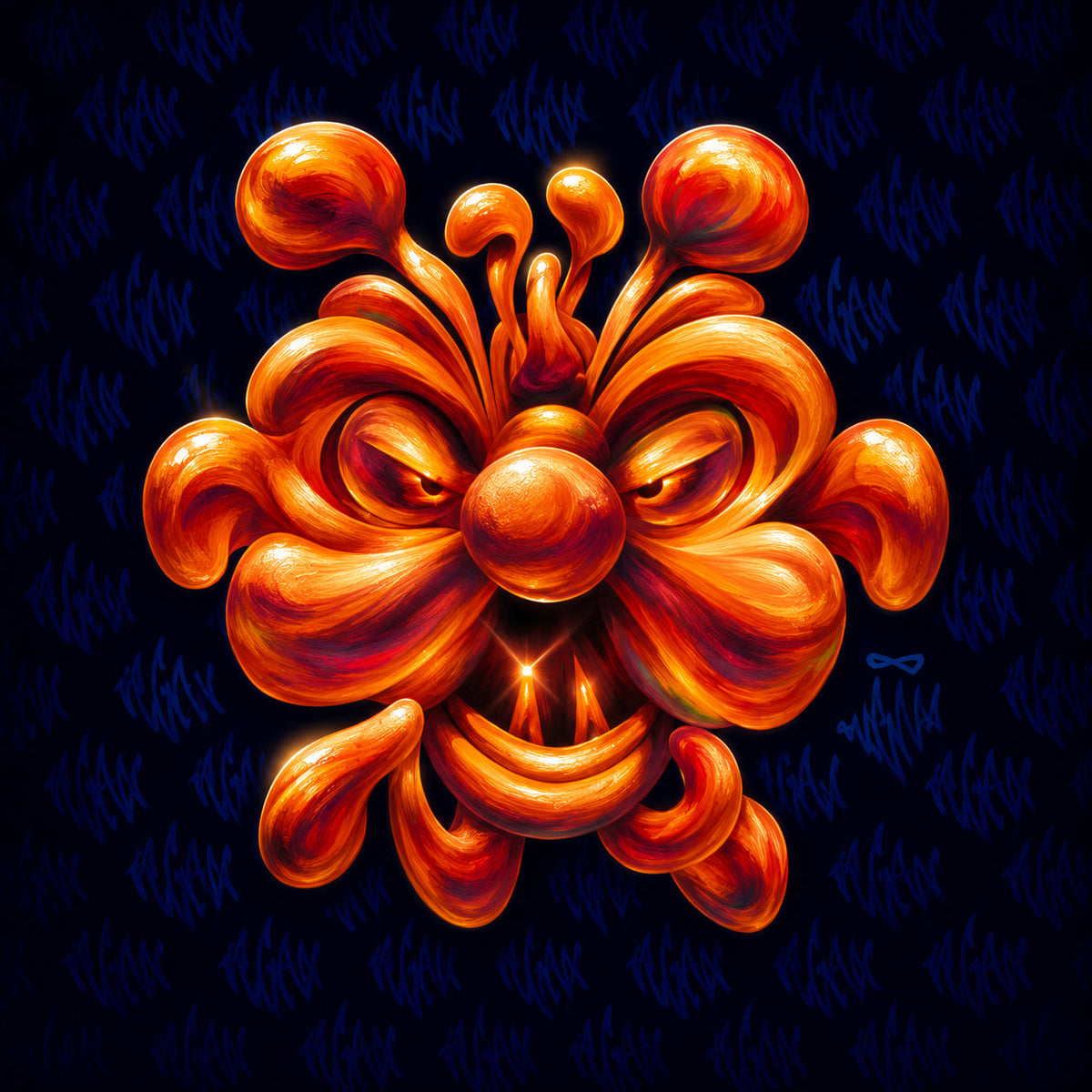
In that sense, my character Svenimal is a cartoon-like combination of my own identity and all kinds of elements drawn from completely different artistic influences, but clearly with a graffiti-cartoon (and Vaughn Bode-like) basis.

The Svenimal character


Decks signed by Tony Hawk, Ice-T and Public Enemy
Some of the skateboard artworks in your personal collection are signed by Ice-T, Tony Hawk and Public Enemy. Is there one piece or story from that collection that means something special to you?
Because I work with different materials and subjects, every deck has its own meaning to me.
The one signed by Tony Hawk, for instance, wasn't originally made with him as the subject.
Back in 2015, I found the bones and skull of a bird just outside my garden. I picked them up and boiled them to remove the remaining organic material, leaving just the bones. Then, with the help of the internet, I made a sketch of the skull.
Since Powell Peralta (an old-school skateboard brand) has used quite a few skull graphics over the years, as has Birdhouse, I came up with the idea of painting it on an original Powell Peralta deck, with a background in a similar style.
Seven years later, I went to see Tony Hawk in Antwerp, where he was giving a talk.
I made another version of the painting to give to him. I didn't buy a meet-and-greet ticket because of the additional cost of the trip, but I tried to hand him the deck after he left the stage. Unfortunately, he exited on the other side.
Then a young guy who looked like a surfer, and who had bought a meet-and-greet ticket, approached me and offered to take the deck with him.
That eventually resulted not only in a signed deck, but also in a photo of my artwork appearing on Tony's Instagram!
As a thank-you, I later painted a deck for this guy, depicting him holding the deck that had been sold at the An Evening with Tony Hawk event, along with Tony posing in a T-shirt from the guy's band. He really appreciated it.
On his YouTube channel he published a making-of video of the Tony Hawk tribute, titled Skateboard Art #3 Tribute to Tony Hawk and skateboard culture SIGNED! | Hawk @ Rivierenhof, Antwerp. The title matches his account of going to see Tony Hawk in Antwerp.


More painted skateboards
His gallery also includes boards that sit slightly outside the ten answers but show the same habit of turning a blank or worn deck into a finished piece — including a Pink Panther board that matches a making-of video on his channel, and a Das EFX tribute.


When a skateboard becomes a piece to hang on the wall
Most of your painted skateboards are unique one-of-one pieces. What changes for you when a skateboard stops being just a functional object and becomes an artwork someone hangs on a wall?
As I mentioned before, some of these worn-out decks are already works of art in their own right.
But with every deck I work on, there's a moment when I sand it down and it starts its transformation into a piece of art.
For me, it's finished and ready to hang on a wall when I can no longer see any way to improve the painting.
That idea of a used deck as a canvas, and then as something ready to hang, is also the subject of deckarts articles on how graffiti shaped skateboard deck art and on how to choose skateboard wall art, including how to frame and display a deck. Where deckarts prints a deck, it is printed by hand in Berlin, on 7-ply maple, and ships from Berlin. Decks are not ready to hang: a wall mount is sold separately, one per deck. None of this is a Svenimal deckarts collaboration; his painted boards are his own one-of-one pieces.
Digital drawings and limited edition prints
You’re also exploring ways to transform older drawings and photographs into digital artwork and limited edition prints. What interests you about moving from physical, often unique pieces into a reproducible digital format?
Actually two reasons:
1) I see drawing digitally as another medium, where I can draw and quickly can combine all kinds of markers and inking tools and quickly draw and erase. I also can use an airbrush (which I don’t have at the moment) etc.
All details will be exact as you draw them in your design where as I paint or woodburn I transfer the drawing and then go over it and it’s harder to maintain the original details.
2) I really want to have more interaction with audience and other artists and the only way to achieve that is to expose work at expo’s. As I won’t sell my originals, this printed art gives me the chance to sell art and gain some attention to my art.
I have to say that I always work out basic ideas digitally with Procreate or Photoshop.
I don’t think my process of working out digitally is much faster than an original.
Follow Svenimal
Website: svenimal.art
Instagram: @svenimal.art
YouTube: @svenimal-art
Facebook: Svenimal.Art
Photos: svenimal.art
FAQ
Who is Svenimal?
Svenimal is the artist name of Sven Bakker, a Dutch drummer, drum teacher, graphic artist and drawing teacher based in the Hoorn area of the Netherlands. He founded Studio Svenimal, his drum and drawing school, in 2005, and he paints murals, portraits and one-of-one skateboards.
What kind of skateboard art does Svenimal make?
Unique, one-of-one painted decks, often on worn or old-school shapes. He works with a wide range of materials, including pyrography, acrylics, coloured pencils and liquid charcoal, and he usually works out basic ideas first in Procreate or Photoshop.
Did Tony Hawk sign one of Svenimal’s decks?
In this interview Svenimal says he painted a bird-skull on an original Powell Peralta deck after finding a bird’s bones in 2015, later made another version to give Tony Hawk at a talk in Antwerp, and that this led to a signed deck and a photo of the artwork appearing on Tony’s Instagram. His site also includes a screenshot of a Tony Hawk Instagram story, tagged Copenhagen, showing the purple painted deck. This article does not add details beyond his own words and that screenshot.
Why does Svenimal like painting worn skateboard decks?
He treats scratches, stickers and weathered wood as part of the story. A worn-out deck, he says, is already a piece of art; customising it means turning that object into a painting, while still leaving some of the wood or its structure visible.
Has Svenimal designed a deckarts skateboard deck?
No. The boards in this interview are his own painted, one-of-one pieces. Deckarts has not produced a Svenimal collaboration deck.
Where can I follow Svenimal?
On his website svenimal.art, on Instagram at @svenimal.art, on YouTube at @svenimal-art, and on Facebook at Svenimal.Art. Links are in the Follow Svenimal section above.
Are deckarts skateboard decks ready to hang?
No. A wall mount is sold separately, and you need one per deck.
More artist interviews
More conversations with artists are on the deckarts skateboard art blog:
- Luis Sena: vibrant energy, movement and a sun-and-moon deck idea
- Lusin Ginosyan: ducks, freedom and playful contrast
- Bub: character art, curiosity and skateboard decks
- Ziva Hardaway: expressive portraits and a narrative universe
- Delletuefiammeavide: India ink bestiaries and surreal hybrids
- From street art to skate decks: how graffiti shaped skateboard deck art
- How to restore an old skateboard for wall display
- Skateboard frame: how to frame and display a deck


0 commenti